
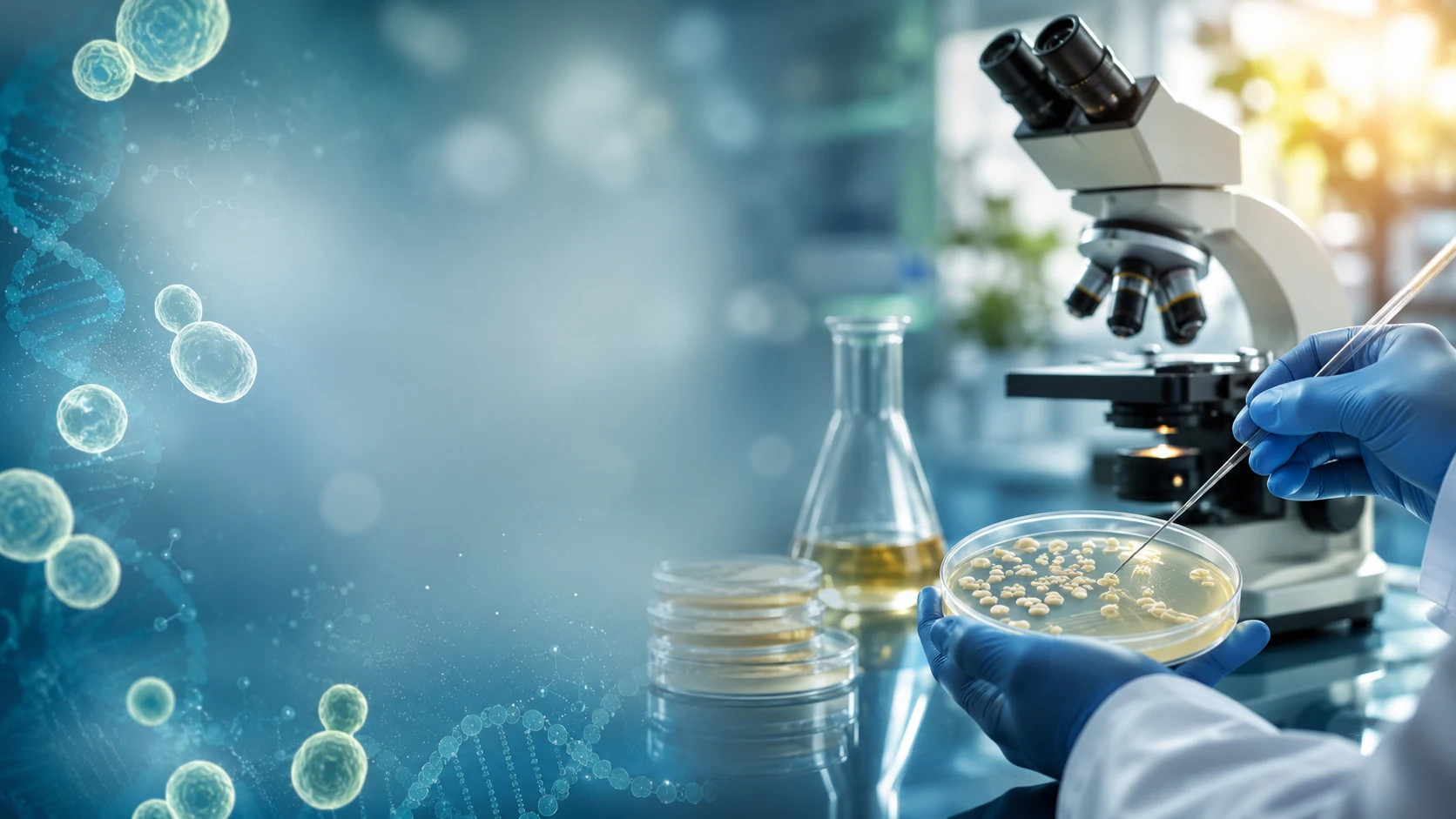
Why Study Aging in a Single-Celled Organism?
Yeast cannot reproduce the full physiology of a human or even a simple animal, but many fundamental eukaryotic processes are shared. DNA repair, chromatin regulation, mitochondrial function, nutrient sensing, autophagy, protein quality control and stress responses can all be studied in yeast with remarkable experimental precision.
That simplicity is an advantage when the goal is mechanism. Researchers can change a gene, nutrient or chemical condition and measure how cells respond without many of the confounding variables present in a multicellular organism.
Yeast also grows rapidly and is inexpensive to culture, which allows large numbers of strains or conditions to be tested in parallel.
Genetic Tractability and Experimental Control
S. cerevisiae has a deeply characterized genome and an extensive toolkit for deleting, modifying or overexpressing genes. Collections of defined mutants have enabled systematic screens for genes that alter lifespan or stress resistance.
Because cells can be grown in standardized media under controlled temperature, aeration and nutrient conditions, researchers can repeat experiments across many biological replicates. Experimental control does not eliminate variability, but it makes sources of variability easier to identify and test.
These features helped aging researchers discover conserved relationships involving TOR signaling, insulin-like signaling analogs, sirtuins, AMPK-related pathways, mitochondrial stress and cellular maintenance.
Two Major Yeast Lifespan Models
Yeast aging is usually studied with two distinct assays. Replicative lifespan asks how many daughter cells one mother cell can produce before it permanently stops dividing. Chronological lifespan asks how long non-dividing cells remain viable after entering a stationary or nutrient-limited state.
The two models capture different biological questions. Replicative lifespan emphasizes repeated cell division and asymmetric inheritance between mother and daughter cells. Chronological lifespan emphasizes survival during a non-dividing state and adaptation to nutrient depletion.
Read Yeast Chronological Lifespan for a detailed explanation of the second model.
Why Yeast Works for High-Throughput Aging Studies
Short timescales and small culture volumes make yeast suitable for screening. Researchers can compare many genetic variants, nutrient conditions or compounds in multiwell formats and then prioritize the strongest findings for deeper study.
High-throughput methods are especially valuable because aging phenotypes can be influenced by interactions among many genes and pathways. Screens can reveal unexpected connections that would be difficult to find one hypothesis at a time.
Sageweb's historical YODA resource is an example. YODA automated analysis of optical-density outgrowth data to estimate survival and growth characteristics in yeast chronological lifespan experiments.
What Yeast Can Reveal About Conserved Aging Biology
A key reason yeast remains relevant is evolutionary conservation. Core pathways that regulate growth, stress responses, metabolism and cellular maintenance often have functional counterparts in worms, flies and mammals.
This does not mean a yeast lifespan result automatically predicts human longevity. Instead, repeated effects across distant organisms increase confidence that a pathway represents a fundamental biological mechanism worth investigating in more complex models.
Comparative research across yeast, C. elegans, Drosophila and mice has been particularly influential in establishing nutrient-sensing and stress-response pathways as recurring regulators of lifespan.
Important Limitations of Yeast Aging Models
Yeast is unicellular. It cannot model organs, adaptive immunity, circulation, endocrine systems, cognition or the interactions among specialized tissues. Its metabolism also differs from mammals in important ways, and experimental media can strongly affect lifespan outcomes.
Chronological lifespan assays are sensitive to factors such as nutrient composition, culture density, pH, aeration and the method used to define viability. Replicative assays have their own technical challenges and biological interpretation.
For this reason, strong conclusions come from combining yeast experiments with additional models. See Model Organisms in Longevity Research.
From Yeast Discovery to Broader Aging Research
The best use of yeast is often discovery and mechanism testing. A finding can be mapped to orthologous genes or pathways in other organisms, tested in worms or flies, examined in mammalian cells and eventually evaluated in mice or human data where appropriate.
This staged approach is more informative than asking whether yeast is a miniature human. Each model contributes evidence at a different level of biological complexity.
Sageweb's Model Organisms pillar provides the broader context for choosing models based on the question being asked.
Reproducibility in Yeast Aging Experiments
Yeast is experimentally convenient, but convenience does not make every lifespan result automatically reproducible. Strain background, media composition, carbon source, culture density, temperature, aeration and plate layout can all influence growth and survival. Small procedural differences may become important when experiments last for many days.
Well-designed studies therefore use independent biological replicates, defined media, appropriate controls and explicit reporting of assay conditions. Large screens are often followed by secondary validation using fresh cultures or alternative measurements to distinguish robust effects from technical artifacts.
This emphasis on reproducibility is one reason yeast is valuable for method development. Variables can be controlled and retested quickly, allowing researchers to refine an assay before applying related questions to slower and more expensive animal models.
The Practical Value of a Fast Experimental System
Aging experiments create a practical problem: the longer an organism lives, the more time, space and resources are required to complete a study. Yeast compresses many experimental cycles into days or weeks. Researchers can move quickly from an initial observation to a targeted genetic test, then repeat the experiment under alternative nutrient or stress conditions.
This speed is especially useful for hypothesis generation. A genome-wide screen can identify dozens or hundreds of candidate genes, after which the strongest candidates can be retested individually. Researchers can then examine whether those genes influence mitochondrial function, autophagy, stress resistance, metabolism or other cellular systems associated with longevity.
Yeast also supports quantitative method development. Growth curves, fluorescence measurements, colony formation and automated plate-reader assays can generate large datasets that are suitable for computational analysis. Historical tools such as YODA illustrate how aging research and bioinformatics can intersect: software can transform repeated measurements into survival estimates while preserving the need for careful experimental controls and biological interpretation.
Questions Yeast Cannot Answer Alone
Yeast is strongest when the question concerns conserved cellular machinery, but many important aging questions require multicellular biology. Researchers cannot use budding yeast alone to study interactions between immune cells and tissues, vascular aging, endocrine feedback, cognitive decline, skeletal-muscle function or the effects of a drug as it is absorbed and distributed through a mammalian body.
These limits are not weaknesses so much as boundaries of the model. A well-designed research program uses yeast where its simplicity provides leverage and then moves to another system when the question changes. This division of labor is one reason canonical model organisms remain complementary rather than competing platforms.
Understanding those boundaries also improves science communication. A yeast result may identify a conserved target or cellular response without establishing a human treatment effect, and that distinction should remain explicit when longevity findings are discussed outside the laboratory.