
Why Longevity Research Needs Model Organisms
An ideal experiment controls genetics, environment and intervention timing while following enough individuals to compare survival and age-related function. This is feasible in short-lived laboratory organisms but rarely possible in humans.
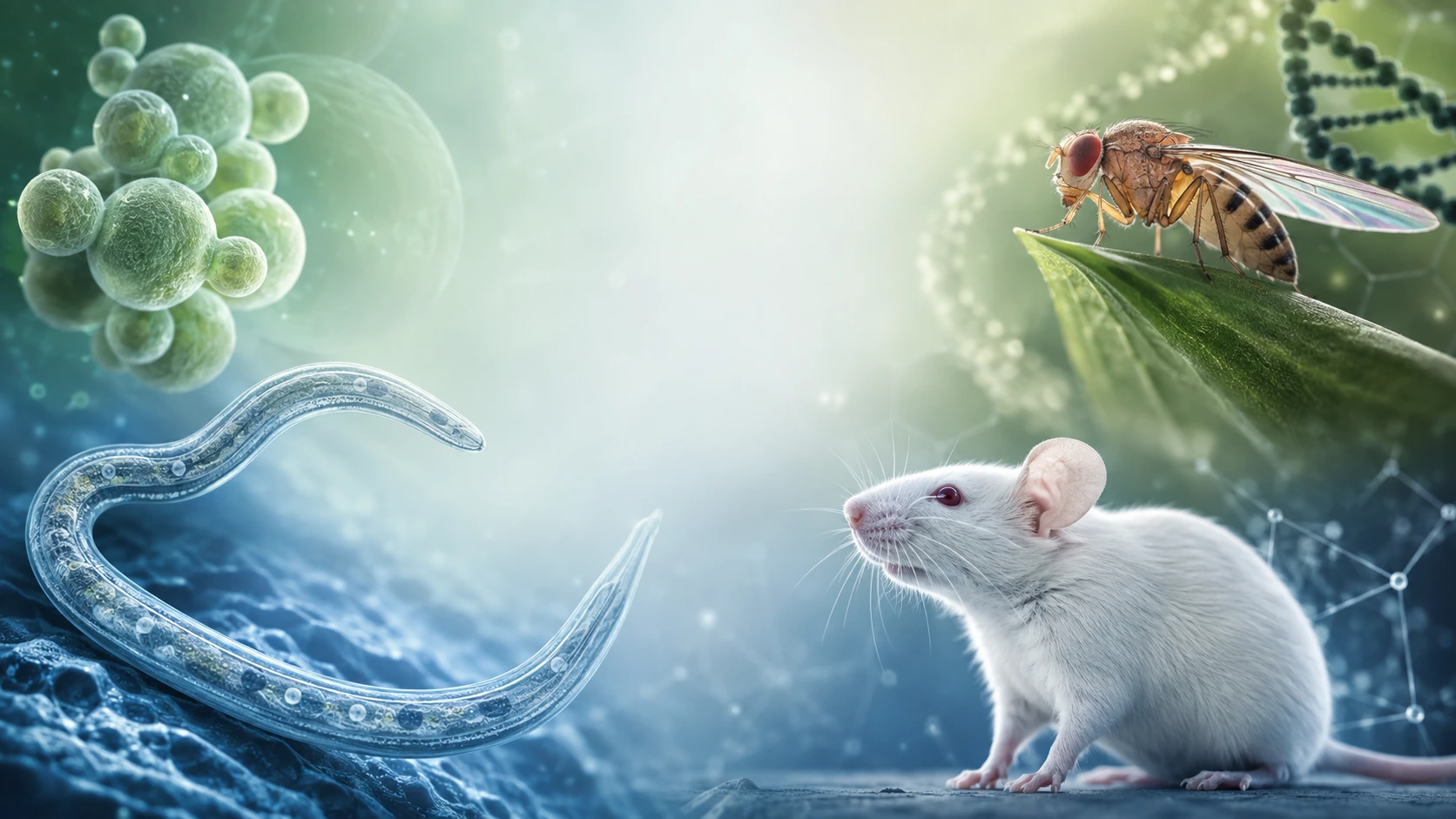
Model organisms also offer specialized tools. Yeast supports large genetic screens, C. elegans allows whole-animal studies in a transparent body, Drosophila combines powerful genetics with complex tissues and behavior, and mice provide mammalian physiology and organ systems.
No model is universally best. The strongest strategy is to choose the organism that can answer a specific question and then test whether the result survives comparison across systems.
Yeast: Cellular Mechanisms and High-Throughput Discovery
Saccharomyces cerevisiae is particularly powerful for investigating conserved cellular processes. Researchers study both replicative lifespan and chronological lifespan, allowing different aspects of cellular aging to be measured.
Yeast genetics and culture methods make genome-scale screens practical. Work in yeast has contributed to the study of TOR signaling, sirtuins, mitochondrial function, autophagy and stress resistance.
Its limitation is equally clear: a single-celled organism cannot model interactions among mammalian organs. Yeast findings become more persuasive when related mechanisms are observed in multicellular organisms.
C. elegans: Whole-Animal Aging on a Short Timescale
The nematode Caenorhabditis elegans has a short lifespan, well-characterized development and extensive genetic tools. Its small transparent body makes it possible to connect gene activity with whole-animal phenotypes and tissue-specific changes.
Classic longevity genetics in C. elegans helped establish that lifespan can be modified by defined pathways rather than being only a passive consequence of accumulated damage. Insulin/IGF-like signaling became one of the most influential examples.
Worms still lack many features of mammalian physiology, so their greatest value is often rapid causal testing at the level of a complete animal.
Drosophila: Genetics, Tissues and Behavior
Drosophila melanogaster combines short generation times with complex organs, nervous-system function, behavior and metabolism. Researchers can manipulate genes in specific tissues and examine how those changes affect lifespan or functional aging.
Fruit flies have been important for work on nutrient sensing, mitochondrial biology, proteostasis, stem-cell function and neural aging. Their extensive genetic toolkit enables experiments that bridge some of the gap between worms and mammals.
As with other invertebrates, major anatomical and physiological differences limit direct extrapolation to humans.
Mice: Mammalian Physiology and Intervention Testing
Mice provide a mammalian system with organs, immune function, endocrine signaling, metabolism and pathology that are much closer to humans than invertebrate models. They are therefore central to testing whether conserved mechanisms produce meaningful effects in mammalian aging.
Mouse longevity studies are more expensive and slower than experiments in yeast, worms or flies. Lifespan can also vary with strain, sex, housing, diet and pathogen status, which makes rigorous design and replication essential.
Because mice can be evaluated for disease, function and pathology throughout life, they are particularly valuable for separating simple lifespan extension from broader healthspan effects.
Conserved Pathways Across Species
Comparative research has repeatedly highlighted pathways related to mTOR, AMPK, insulin/IGF signaling, sirtuins, mitochondrial stress and cellular maintenance. The details differ among species, but recurrence across distant organisms suggests that core relationships between growth, nutrients, stress and repair are evolutionarily old.
Conservation is evidence, not proof of clinical relevance. A pathway can be shared while the appropriate intervention, dose, timing and physiological consequence differ substantially between species.
Cross-species consistency is most useful for prioritizing mechanisms that deserve more detailed mammalian and human investigation.
Choosing the Right Model for the Question
If the question is whether a gene affects a conserved cellular process, yeast may be sufficient for discovery. If the question requires a nervous system or tissue interactions, worms or flies may be more informative. If organ-level disease, pharmacokinetics or mammalian immune function matters, mice may be necessary.
Researchers also increasingly use cell culture, organoids, naturally long-lived species and comparative biology to complement canonical models. These approaches help reveal mechanisms that might be missed when research focuses on only a few laboratory species.
See Sageweb's broader Model Organisms in Aging Research overview for additional context.
From Model Lifespan to Human Longevity
A longer lifespan in a model organism is a starting point for investigation, not evidence that the same intervention will extend human life. Translation requires understanding mechanism, safety, exposure, functional outcomes and whether relevant biology is conserved.
Healthspan measures are especially useful because they can reveal tradeoffs. An intervention that extends survival while reducing growth, fertility or function may have a very different interpretation from one that preserves multiple dimensions of health.
Read Lifespan vs Healthspan for a closer look at these outcome differences.
Why Replication Across Species Matters
A mechanism becomes more compelling when related effects are observed in multiple evolutionary contexts. If a nutrient-sensing pathway influences lifespan in yeast, worms, flies and mice, researchers gain evidence that the relationship is not limited to one unusual species or laboratory assay. Cross-species replication can also reveal which parts of a pathway are deeply conserved and which are species-specific.
However, replication does not require identical phenotypes. An intervention may alter lifespan in one organism but primarily affect disease, stress resistance or metabolic function in another. Those differences can be informative because they show how conserved molecular machinery is embedded in distinct physiologies.
The most useful research programs therefore combine depth and breadth: detailed mechanism in a tractable model, confirmation in another organism, and increasingly relevant functional outcomes as the work moves toward mammals and human studies.
Building an Evidence Chain Across Models
Longevity research often progresses as an evidence chain rather than a single decisive experiment. A genetic screen in yeast or worms may identify a pathway, a fly study may reveal tissue-specific effects, and a mouse experiment may test whether the mechanism changes mammalian physiology, disease burden or survival. Human observational or clinical data can then ask whether the same biology is relevant in people.
Each step adds something different. Simpler models offer speed and experimental control; more complex models add physiology and translational relevance. When results disagree, that disagreement can expose hidden variables such as sex, diet, developmental timing, genetic background or tissue-specific effects.
This layered approach also protects against overinterpretation. A dramatic lifespan extension in one species can be scientifically important without being a treatment recommendation. The most durable conclusions in aging biology usually emerge when multiple models, independent laboratories and different types of measurement converge on the same underlying mechanism.
Beyond the Classical Four
Yeast, worms, flies and mice dominate much of experimental aging research, but they do not capture the full diversity of lifespan strategies found in nature. Comparative studies of bats, naked mole rats, long-lived fish and other species can reveal biological adaptations that are difficult to discover in standard laboratory models.
Nontraditional systems are particularly useful when the question concerns exceptional longevity, cancer resistance, regeneration or unusual metabolic states. They complement rather than replace classical models, adding evolutionary breadth to mechanisms first studied under highly controlled laboratory conditions.