Biology of aging
Cellular senescence, genome maintenance, mitochondria, proteostasis, epigenetics, nutrient sensing and other mechanisms form the biological foundation of aging research.


Aging and longevity research is inherently interdisciplinary. Molecular experiments can reveal mechanisms, model organisms can test causality, databases can organize observations, and human studies can evaluate whether findings remain relevant in more complex real-world settings.
Sageweb's research hub connects these layers. The goal is not to treat every study as equivalent, but to make it easier to see what question was asked, what system was used, how the result was measured and how confidently it can be generalized.
Cellular senescence, genome maintenance, mitochondria, proteostasis, epigenetics, nutrient sensing and other mechanisms form the biological foundation of aging research.
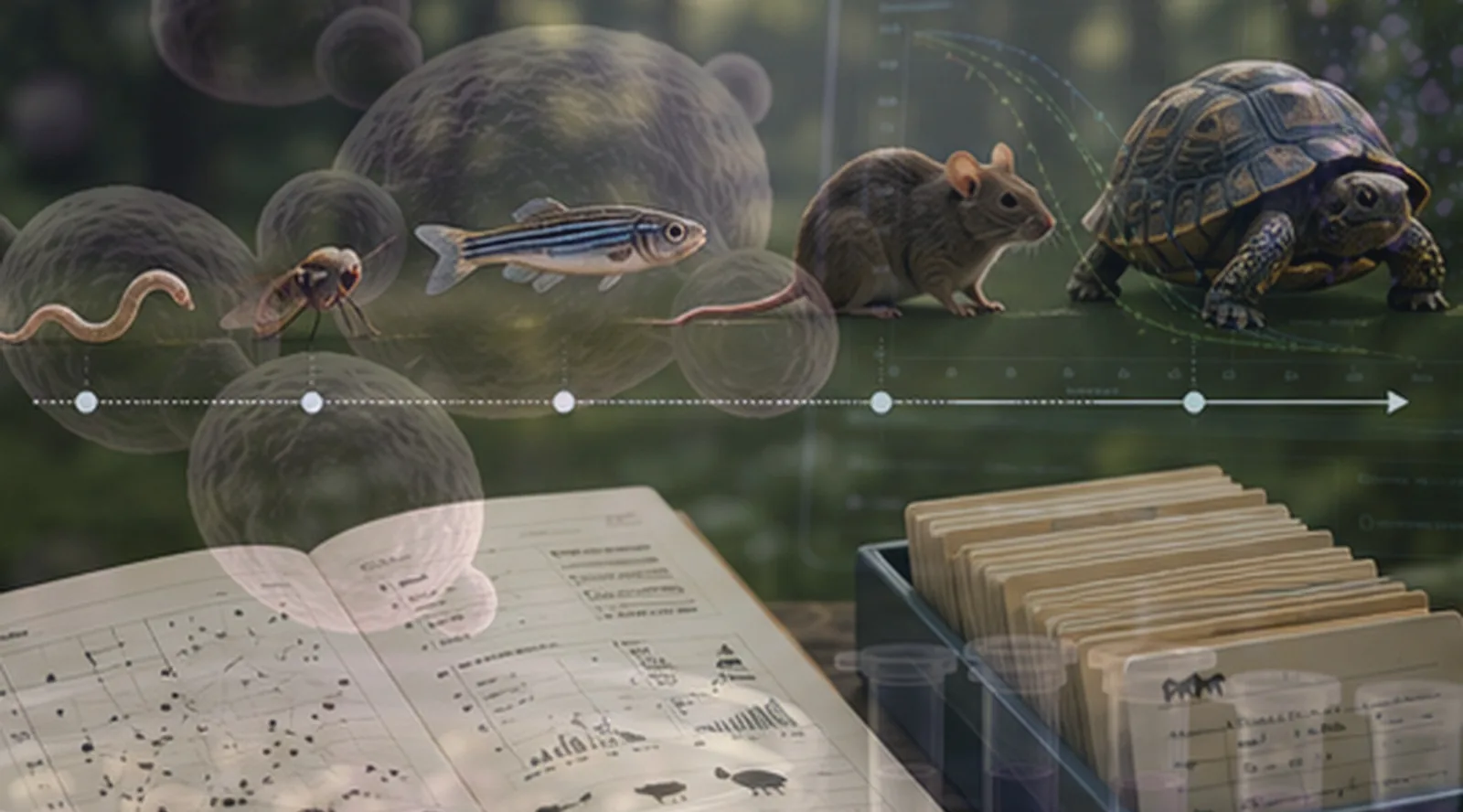
Yeast, worms, flies and mice enable controlled tests of genes, pathways and interventions that are difficult or impossible to perform in humans.
Research databases connect genes, compounds, interventions, phenotypes and publications so findings can be compared across experiments and species.
Strong conclusions usually emerge from multiple methods and repeated observations rather than a single experiment. Understanding study design helps separate an interesting result from a robust scientific finding.
Research begins with a specific question: which pathway changes with age, whether a gene affects lifespan, or how an intervention changes a measurable phenotype.
The organism, assay, comparison groups, sample size and experimental conditions determine which conclusions a study can support.
Researchers may measure survival, growth, molecular markers, pathology, behavior or functional performance depending on the question.
Statistical and computational methods help estimate effects, uncertainty and whether patterns are consistent with the proposed explanation.
Replication across experiments, laboratories, genetic backgrounds or species strengthens confidence and exposes conditions where an effect changes.
Moving from basic biology to human health requires additional evidence because physiology, exposure, dose and timescale can differ substantially.
Software and data resources reduce repetitive work, standardize analysis and make published observations easier to compare. Sageweb's history includes YODA, a tool for analyzing yeast outgrowth data, and the Lifespan Observations Database, which organized published lifespan findings across species.
These resources illustrate two complementary sides of research infrastructure: one helps analyze experimental measurements, while the other helps organize observations after studies are published.
Species, strain, sex, age, intervention timing, dose, laboratory conditions and statistical methods can all influence an aging study. A result should therefore be interpreted within the design that produced it.
For health-related topics, Sageweb distinguishes mechanistic evidence from clinical evidence and avoids treating findings in model organisms as established human outcomes.
Basic experiments are valuable for discovering mechanisms, while observational studies can reveal patterns in populations and clinical trials can test defined interventions in people. These designs are complementary rather than interchangeable. A mechanistic result can explain how something might work, but it cannot by itself prove a health benefit.
Controlled laboratory studies can manipulate genes, pathways and environments to test cause-and-effect relationships with a level of precision rarely possible in humans.
Cohort and epidemiological studies identify associations between exposures, biomarkers and outcomes, but confounding factors can complicate causal interpretation.
Randomized and controlled studies can provide stronger evidence about interventions when they are feasible, appropriately designed and large enough to detect meaningful effects.
Use these pages to move between mechanisms, model systems, software and lifespan data.