
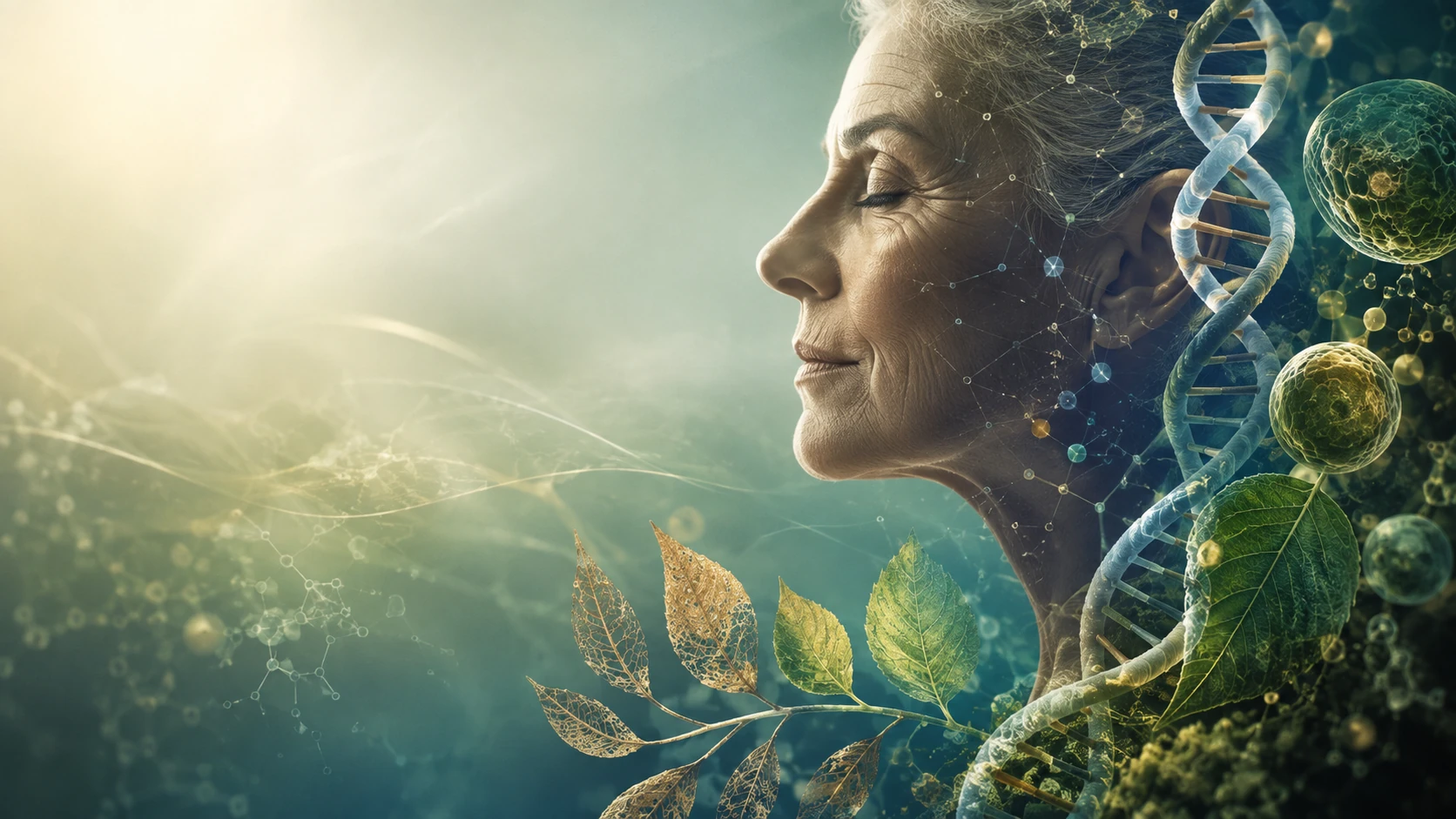
What Biological Aging Means
Chronological age is simply time since birth. Biological aging refers to the age-related state of the body: the accumulated molecular damage, changes in cellular behavior, loss of physiological reserve and increasing difficulty maintaining homeostasis. Two people of the same chronological age can therefore differ in functional capacity, disease risk and molecular markers associated with aging.
Aging is also distinct from any single age-related disease. Cancer, cardiovascular disease, neurodegenerative disorders and metabolic disease become more common with age, but none is a complete definition of aging. Researchers instead study the underlying processes that change vulnerability across many tissues and diseases.
This distinction matters because a useful theory of aging should explain patterns that appear across multiple levels of biology. It should connect molecular changes inside cells with tissue function, organismal resilience and ultimately survival.
Why Do We Age?
No single mechanism explains aging in every organism. Evolutionary history, imperfect maintenance, accumulated damage and regulated responses to stress all contribute. Some changes are clearly harmful; others begin as protective responses and become maladaptive when they persist for too long.
Modern aging research therefore treats aging as a network. DNA repair, nutrient sensing, mitochondrial function, protein quality control, autophagy, inflammation, stem-cell activity and intercellular signaling influence one another. A disturbance in one area can increase pressure on several others.
This network view also explains why interventions that affect one pathway can produce broader effects in model organisms. Altering nutrient-sensing pathways, for example, can change metabolism, stress resistance, autophagy and mitochondrial activity at the same time.
From Mechanisms to the Hallmarks of Aging
The Hallmarks of Aging framework was introduced to organize recurring biological features associated with aging. The original 2013 framework described nine hallmarks, including genomic instability, telomere attrition, epigenetic alterations, loss of proteostasis, deregulated nutrient sensing, mitochondrial dysfunction, cellular senescence, stem-cell exhaustion and altered intercellular communication.
An updated framework published in 2023 expanded the list to twelve by explicitly including disabled macroautophagy, chronic inflammation and dysbiosis. The hallmarks are not independent checkboxes. They interact, and the strength of evidence differs among mechanisms, tissues and experimental systems.
For a closer look at the framework, see Sageweb's guide to the Hallmarks of Aging.
Aging Happens at Multiple Levels
At the molecular level, researchers can observe changes in DNA integrity, chromatin state, RNA processing, protein turnover, metabolites and signaling. At the cellular level, cells may alter their capacity to divide, repair damage, recycle components, generate energy or communicate with neighboring cells.
Tissues add another layer. Aging can change immune composition, extracellular matrix properties, vascular function and the balance between cell loss and regeneration. These tissue-level effects eventually influence whole-organism outcomes such as strength, cognition, stress tolerance, fertility and recovery from injury.
Because aging is multilevel, no single measurement captures the entire process. A molecular biomarker can be informative without fully describing functional health.
How Researchers Measure Biological Aging
Researchers use combinations of molecular, cellular and physiological measures. Examples include DNA methylation patterns, circulating proteins and metabolites, immune-cell profiles, imaging, organ function and physical performance. Composite aging clocks attempt to combine multiple signals into estimates that correlate with chronological age, health outcomes or mortality risk.
A useful biomarker should be reproducible, meaningfully related to age-dependent biology and ideally responsive when the underlying process changes. That standard is difficult to meet. Some biomarkers are excellent predictors without being causal mechanisms; others may measure a specific tissue rather than systemic aging.
Longitudinal studies are especially valuable because they follow the same individuals over time. They can distinguish stable differences between people from true within-person biological change.
What Model Organisms Add
Human aging unfolds over decades, making controlled mechanistic experiments difficult. Model organisms allow researchers to perturb genes, pathways and environments while measuring lifespan or age-related function over much shorter timescales.
Yeast, nematode worms, fruit flies and mice have each revealed conserved pathways that influence longevity. These models differ in complexity and cannot reproduce every aspect of human aging, so translation requires evidence across systems rather than a direct leap from one organism to people.
Explore the broader context in Model Organisms in Aging Research and Model Organisms in Longevity Research.
What Biological Aging Does and Does Not Tell Us
The idea of biological age is useful because chronological age alone does not capture variation in physiology. But it should not be treated as a single hidden number that can be measured perfectly. Different clocks and biomarker panels may emphasize different aspects of aging and can produce different estimates for the same person.
Research findings are strongest when the measurement matches the question. A marker that predicts mortality may not identify the mechanism causing a change, while a mechanistic assay in cells may not predict long-term human outcomes.
For readers evaluating longevity claims, the key questions are whether an intervention changes a validated biological process, whether the effect improves function or healthspan, and whether the evidence extends beyond a single model or surrogate marker.
Key Takeaways
- Biological aging is the progressive change in molecular, cellular and physiological function over time.
- Chronological age and biological age are related but not identical.
- Aging involves interacting mechanisms rather than one universal cause.
- Biomarkers can estimate aspects of aging but no single marker captures the entire process.
- Model organisms are essential for mechanism discovery, while human translation requires additional evidence.
Why Study Design Matters in Aging Research
Aging studies can look very different depending on whether researchers examine cells, laboratory animals, clinical cohorts or population data. A cross-sectional study compares different age groups at one moment in time, while a longitudinal study follows the same individuals as they grow older. Longitudinal designs are especially useful for separating true within-person change from stable differences among individuals.
Intervention studies add another layer. In a model organism, researchers may alter a gene, nutrient or drug exposure and measure lifespan, stress resistance and molecular outcomes. Human studies generally rely more heavily on observational cohorts and clinical endpoints. The strength of a conclusion depends on matching the method to the question rather than assuming that every type of evidence is interchangeable.
This is also why biological-age measures need careful validation. A clock may be statistically accurate at estimating age while still providing limited information about which mechanism is changing. Researchers therefore combine predictive biomarkers with mechanistic studies and functional measurements.
Aging, Disease and Resilience
One of the most important ideas in geroscience is that aging changes the background on which many diseases develop. With advancing age, tissues may become less able to recover from stress, repair damage or return to a stable physiological state after infection, injury or metabolic disruption. This declining reserve can increase vulnerability even when no single disease explains the entire change.
At the same time, aging and disease should not be collapsed into the same concept. Some older people retain high function despite substantial chronological age, while younger individuals can develop diseases usually associated with later life. Researchers therefore study both disease-specific pathways and the broader biological processes that influence resilience across multiple organs.
This perspective helps explain why aging research often measures recovery, stress tolerance and functional reserve in addition to static biomarkers. A system that looks normal at rest may reveal age-related limitations when challenged. Understanding resilience may therefore provide information that a single blood marker or molecular clock cannot capture on its own.